Getting excited about this Central Province village trip. We are going to have an excellent time! I spoke to the participants tonight on a teleconference call; it was less strained than I imagined, and everyone sounds pretty good. It is a small group (only 6 others), which will be much easier to manage than a larger one. It was fun explaining to the kids what village life is like, and what things they might encounter. It reminded me that it is actually quite hard to imagine the lifestyles here, without experiencing them first hand.
Village 1 is about 100 people. Access is via a river, using a swing bridge. Wash in the river. Village 2 is bigger, but more remote, up a heavily forested mountain. Language is Hotu - not Motu; I hadn't even heard of this one before. Wash in a waterfall 100m away, or swim in river 1 hour's walk away. Fly in to nearby airstrip, hike for a few hours to get there. Needless to say, neither have electricity. Most people are SDA - there are twice daily services! And both are currently building us pitpit toilets.
Bring it on.
**
Yet saying that: today at work I felt that familiar twinge you get when you leave a place you have known, where you are known, where you have made a home and friends. I need to travel, I'm not good when everything's stable and the same - but it's not easy, dragging yourself out again into the unknown.
Still, it's what being alive is all about. And I'll do it again and again.
Tuesday, 20 June 2006

Sunday, 18 June 2006
Lots to do before leaving, but at the same time there's that funny stillness which comes when you're busy and have a departure coming up quick. I sit down and don't do anything, just look at stuff. Everything's about to change and I'm not yet sure how.
 Not related in anyway: jellybaby sculptures, in Cairns. You want to touch them, but they're hard plastic, not soft and squishy. Still, they raise a smile everytime. Jellybaby sculptures. Aha.
 Not related in anyway: jellybaby sculptures, in Cairns. You want to touch them, but they're hard plastic, not soft and squishy. Still, they raise a smile everytime. Jellybaby sculptures. Aha.
Wednesday, 14 June 2006
would you? could you? should you? did you?
 Yes. I am changing roles and taking up something different. Throwing in the editor-gig and becoming a team leader/coordinator, for a group of 6 volunteers from Australia (aged 19-26) who are coming to png for 9 weeks to live in a couple of villages along the kokoda track (2-3 weeks in one place, then we move on. One village is a bit above 2000m - 500m more than where I currently live). We live the village life, work in the gardens and school and wherever needed with local people and maybe do a bit of community development work (this is something under negotiation. Locals can nominate a project they’d like us to help with, or we can come up with one.)
It’s going to be demanding and exacting, and I will have to be switched on at all times - and I can't wait. I wouldn’t have been prepared for it a year and half ago, but now I’m ready, and a bit tougher, and a bit more practical; mi save nau. Goroka was great last year, but coming back this year the challenge has gone, work has wound up and I’ve been bored and feeling flat. I'm waiting to leave, really; to hook up with people back in Australia when this is done. But I don’t want to sit here waiting, wasting time as life drifts by. I want to be out there creating my own stories, saying yes to things. And just as I was thinking along these lines, this opportunity came along. Something more challenging. Something promising a bit of adventure. Something I haven’t done before, that will push me to stretch that bit further.
So anyway – along came this opportunity and I took it (it’s still with the same volunteer org I came over with). Bonus part – I am coming back to Australia for a tiny bit before it all begins [grins]! Have a briefing and have loads of gear to organise and have to go out woopwoop (trans.: Wodonga) to do a 4-day wilderness first aid course – but I’ll be back in my ples.
At the end of it all, we will walk the kokoda track back into Moresby. It will only be about half the track, so will have to come back another time and do the whole thing. Still, it’s something.
Tuesday, 13 June 2006

Monday, 12 June 2006
timor: baucau - com - los palos
From Baucau it was back on a mikrolet and further east to Lautem, then to Com.
 Fish on sticks. Popular road-side snack.
It was worth it though. We stayed in a beautiful balinese-style guesthouse that was one metre from the high-tide mark of the beach. We were the only tourists in the village - but the downside was that we were almost chased by women hawking their thais (a traditional type of weaving, made into long skirts or bags).
 goats are everywhere all over Timor. this one was in com.
We stayed two nights. To leave, we needed to catch a passenger truck out – but the town’s sole truck had broken down. Would we have to walk to get out? Not so fun the second time around...Luckily someone with a mobile called for a mikrolet from Los Palos, and before dawn we were on our way. This was the 20th of May, the anniversary of independence. We got off the mikrolet at the main markets of Los Palos.
 kuskus (type of possum) for sale at markets
From there we caught a local bus into town, and wandered around trying to find some accommodation. Feeling a bit despondent (one horrible room right full of mosquitoes and with a roaring generator parked outside; another nicer place closed), we walked around – and met the only other Aussies in town, who also happened to be volunteers. Excellent people and even offered us a bed for the night.
Now smiling, we went with them to watch the independence celebrations: marching by groups of school kids and local government admin staff. With our new connections, we were able to get seats in the VIP tent – which was good because the sun was hot and the event dragged on for 2 hours. There was a bit more marching late afternoon, but that was it for the celebrations. A French warship that happened to be in the area decided to pull into Dili that afternoon, thinking that there’d be a huge party worth crashing. But there was nothing going on.
Dawn bus back into Dili the next day – a few incidents here – taxi from bus station to our accommodation took some short cut which meant driving along a dry river bed – farewell beer with the volunteers we’d met – dinner at an excellent and cheap Chinese place. Food in Timor much better than PNG: there is range and variety, and spices and flavour to the food.
Next morning there was time for a last wander around the dusty streets before airport + exit.
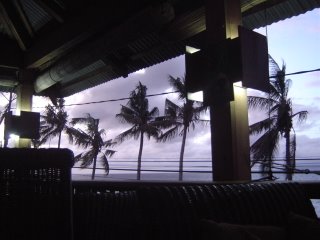 dili cafe
And the next day, Dili exploded.
 Fish on sticks. Popular road-side snack.
 Com was hard to get to, and hard to leave. To get there took a 20k walk. Thought we walk until could hitch a ride, but there was NO traffic at all, so … ended up walking the whole way.
 buffalo being used to plough a rice paddy field, something we passed on the walk
 buffalo being used to plough a rice paddy field, something we passed on the walk
 goats are everywhere all over Timor. this one was in com.
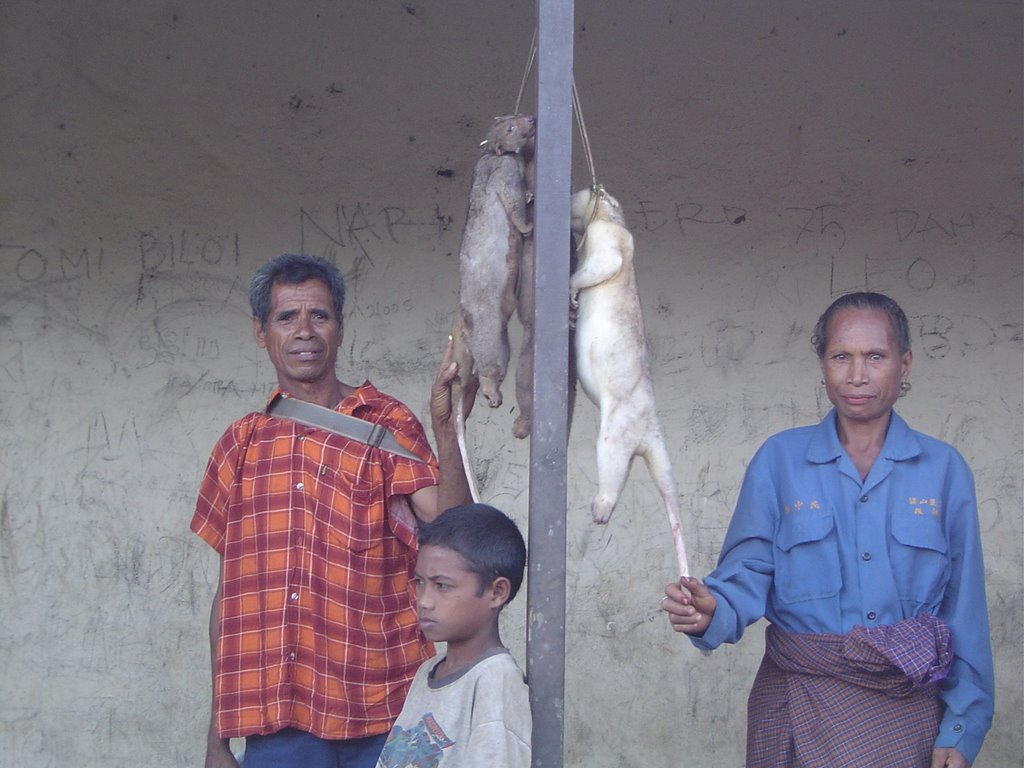 kuskus (type of possum) for sale at markets
Now smiling, we went with them to watch the independence celebrations: marching by groups of school kids and local government admin staff. With our new connections, we were able to get seats in the VIP tent – which was good because the sun was hot and the event dragged on for 2 hours. There was a bit more marching late afternoon, but that was it for the celebrations. A French warship that happened to be in the area decided to pull into Dili that afternoon, thinking that there’d be a huge party worth crashing. But there was nothing going on.
Dawn bus back into Dili the next day – a few incidents here – taxi from bus station to our accommodation took some short cut which meant driving along a dry river bed – farewell beer with the volunteers we’d met – dinner at an excellent and cheap Chinese place. Food in Timor much better than PNG: there is range and variety, and spices and flavour to the food.
Next morning there was time for a last wander around the dusty streets before airport + exit.
 dili cafe
Saturday, 10 June 2006
tourist in dili - baucau
The past few weeks I’ve been out and about. First it was to East Timor (via Cairns and Darwin), for an excellent week of travel. Tip for any future volunteer-travellers: find out if there are other volunteers from your organisation in your country of choice, and arrange to hook up with them whilst you’re there. It is always great to have a friendly face to talk to in a strange place, but they’re invaluable in terms of information – you get the shortcut to best places to eat – markets – things must see and do – places to avoid – local habits to watch out for – language-culture-custom advice – lp guide book – maps – accommodation tips (or maybe even a free bed if you’re lucky) – it’s a fantastic resource. And the bonus was that they were cool and smart and now I’ve got some new friends. Australia Volunteers International seems to have a pretty good screening device – don’t know if anyone’s very good at capacity building or whatever they’re hired for, but they’re certainly great people.
Stayed in Dili for a few days. UN Toyotas everywhere – and this was the reduced presence; can’t imagine what it must have been like 5 years ago. Lunch on first day was a reminder of what it’s like being a traveller – that is, a naïve idiot. Not knowing where to buy food, or any of the local languages, we ended up in a strange empty bakery buying ice cream and a sweet roll, apparently stuffed with peanut butter. Didn’t quite leave me sated, but the sugar gave us energy to climb the stairs up to the huge (20m) statue of Jesus that overlooks the bay Dili sits on. As we climbed up we were overtaken by Portuguese joggers. Climbed back down and rewarded selves with beers at a beach-side café, sitting back as the sun set. Holidays! Volunteering in PNG began to look rather dingy.
As it grew dark we walked up to another beach-side restaurant. Slowly little round bobbling lights appeared above the shallow water, as locals began fishing along the coral reefs at low-tide.
Did a bit of exploring the next day, but a few hours were eaten up booking our tickets to Bali the following week (there are only 2 international flights from Dili – Darwin or Denpasar). Had forgotten this type of admin/planning stuff also takes up a fair bit of time when travelling. Wandered around some markets. Had coffee in the famous Hotel Timor, with a few Portuguese ladies and some NZ police, and lunch with a volunteer mate.
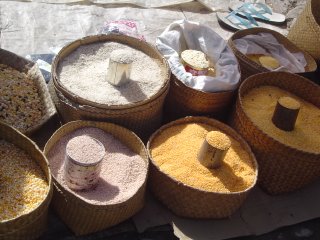 from the markets
The place was pretty quiet, she explained; maybe one third of the locals had fled the city to their villages when there had been riots at the Cormo markets a few weeks previous, when a few people died. Still, if the place was a bit tense it was certainly more relaxed, and safer, than PNG, I thought. On the way back to accommodation for an afternoon nap (it’s hot and everyone siestas, ok), explored some of the shops; entering one computer store, we turned to leave: the cabinets were all empty and the shelves had nothing on them. It looked like it hadn’t yet opened. But the manager called out and told us to wait; he had plenty of stock, it was just “out the back”. He had removed it from display since “the troubles”, he said. It’ll be back to normal next week, he assured us.
Had a Portuguese beer – a Bock – at the UN hangout City Café, which was exciting for me, having read about this place in The Floozy’s Guide to Dili, or something like that, a crappy book by an embarrassing aussie girl I will not give publicity to here.
Next day caught a bus and headed east, along to Baucau. Baucau is the largest town outside of Dili, but it is a pretty sleepy one at that. There was a beautiful old market place in the centre of town. It was built as a crescent shape, overlooking gardens, but the building itself was an empty pink shell. It had been burnt out around the Indonesian withdrawal in 1999, and had been abandoned ever since.
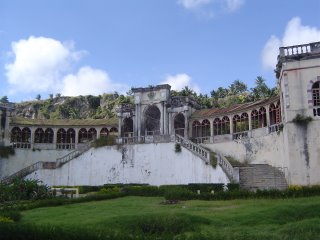
One remarkable feature of Timor’s landscape is the burnt out building. They’re everywhere: ever-present in the streets of Dili, spotted throughout the countryside, and visible at most turns in rural towns and villages. Someone said that 2/3 of buildings are ruins, though I’m not sure that it’s that high. Still, there is an incredible amount of ruins. Rough scars left as part of the environment, not knocked down, not fixed up, not inhabited by the homeless. Just left there.
Baucau: Following advice from the vols, we stayed in Bruno’s guesthouse. Wandered around town, met some other Australian visitors, went to a community centre, wandered past school children being given marching instruction by soldiers; dinner with the other Australians and some vols …
Following day went for a wander down the road we were staying on. Passed fields of rice paddies, and the abandoned Portuguese hospital (oddly, though it hadn’t been used for years the window panes were still intact, doors in place etc. A little graffiti but that was it). My travel buddy had out his big camera and was snapping away. Rounding a bend in the road, someone passed us on a motorbike. We saw a plainclothes guy fiddling with the strap of an M-16. As you do. He was leaning against a police vehicle. He looked up and cheerfully wished us good morning. I wanted a photo of this, but we weren’t sure if it was the right thing to do. We walked a bit further, and then turned and began to head back. The motorbike came up from behind us, and slowed down. “Are you looking for something?” we were asked. As the naïve tourist, I couldn’t pick the tone: was it one of warning? Was it threatening? Or was it just helpful? Had we seen too much? Was the big camera too overt, did we look like we were from the media, was this a problem? Who knows. We just smiled and said no thanks, and walked on.
It was hot in Baucau, and a swim was needed. There was a good looking pool in town, with sunbeds and a well-tended garden; the guidebook said it was filled with the help of natural springs, and it was usually packed out with locals. But today the pool was empty; not a drop inside. So we hiked down to the beach, about 5km down a sometimes steeply twisting road, passing through the usual tropical vegetation dotted with ruins here and there. I love the tropics. Growing up in the driest state of Australia, with eucalypts and dry, tough foliage as “bush”, the stuff in the tropics is more exciting and mysterious, more movie-like.
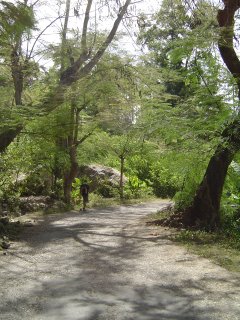
The beach at the bottom was a bit average, but had a quick swim anyway, watched by about 12 kids who lined themselves up, as if for a show. As we began the walk back up the huge, looming hill, a mikrolet (public bus) cunningly purred along beside us and offered us a ride to the top. We ceded and hopped in.
Had a beer in the late afternoon at the town’s biggest hotel – the Pausada, pink and outlandish. They had 3 monkeys in a small cage; one was held to the ground by a 40cm chain attached to a rock. Not sure what custom this is: local? Indonesian? Portuguese?
Stayed in Dili for a few days. UN Toyotas everywhere – and this was the reduced presence; can’t imagine what it must have been like 5 years ago. Lunch on first day was a reminder of what it’s like being a traveller – that is, a naïve idiot. Not knowing where to buy food, or any of the local languages, we ended up in a strange empty bakery buying ice cream and a sweet roll, apparently stuffed with peanut butter. Didn’t quite leave me sated, but the sugar gave us energy to climb the stairs up to the huge (20m) statue of Jesus that overlooks the bay Dili sits on.
 As we climbed up we were overtaken by Portuguese joggers. Climbed back down and rewarded selves with beers at a beach-side café, sitting back as the sun set. Holidays! Volunteering in PNG began to look rather dingy.
As it grew dark we walked up to another beach-side restaurant. Slowly little round bobbling lights appeared above the shallow water, as locals began fishing along the coral reefs at low-tide.
Did a bit of exploring the next day, but a few hours were eaten up booking our tickets to Bali the following week (there are only 2 international flights from Dili – Darwin or Denpasar). Had forgotten this type of admin/planning stuff also takes up a fair bit of time when travelling. Wandered around some markets. Had coffee in the famous Hotel Timor, with a few Portuguese ladies and some NZ police, and lunch with a volunteer mate.
 from the markets
Had a Portuguese beer – a Bock – at the UN hangout City Café, which was exciting for me, having read about this place in The Floozy’s Guide to Dili, or something like that, a crappy book by an embarrassing aussie girl I will not give publicity to here.
Next day caught a bus and headed east, along to Baucau. Baucau is the largest town outside of Dili, but it is a pretty sleepy one at that. There was a beautiful old market place in the centre of town. It was built as a crescent shape, overlooking gardens, but the building itself was an empty pink shell. It had been burnt out around the Indonesian withdrawal in 1999, and had been abandoned ever since.

One remarkable feature of Timor’s landscape is the burnt out building. They’re everywhere: ever-present in the streets of Dili, spotted throughout the countryside, and visible at most turns in rural towns and villages. Someone said that 2/3 of buildings are ruins, though I’m not sure that it’s that high. Still, there is an incredible amount of ruins. Rough scars left as part of the environment, not knocked down, not fixed up, not inhabited by the homeless. Just left there.
Baucau: Following advice from the vols, we stayed in Bruno’s guesthouse. Wandered around town, met some other Australian visitors, went to a community centre, wandered past school children being given marching instruction by soldiers; dinner with the other Australians and some vols …
Following day went for a wander down the road we were staying on. Passed fields of rice paddies, and the abandoned Portuguese hospital (oddly, though it hadn’t been used for years the window panes were still intact, doors in place etc. A little graffiti but that was it). My travel buddy had out his big camera and was snapping away. Rounding a bend in the road, someone passed us on a motorbike. We saw a plainclothes guy fiddling with the strap of an M-16. As you do. He was leaning against a police vehicle. He looked up and cheerfully wished us good morning. I wanted a photo of this, but we weren’t sure if it was the right thing to do. We walked a bit further, and then turned and began to head back. The motorbike came up from behind us, and slowed down. “Are you looking for something?” we were asked. As the naïve tourist, I couldn’t pick the tone: was it one of warning? Was it threatening? Or was it just helpful? Had we seen too much? Was the big camera too overt, did we look like we were from the media, was this a problem? Who knows. We just smiled and said no thanks, and walked on.
It was hot in Baucau, and a swim was needed. There was a good looking pool in town, with sunbeds and a well-tended garden; the guidebook said it was filled with the help of natural springs, and it was usually packed out with locals. But today the pool was empty; not a drop inside. So we hiked down to the beach, about 5km down a sometimes steeply twisting road, passing through the usual tropical vegetation dotted with ruins here and there. I love the tropics. Growing up in the driest state of Australia, with eucalypts and dry, tough foliage as “bush”, the stuff in the tropics is more exciting and mysterious, more movie-like.
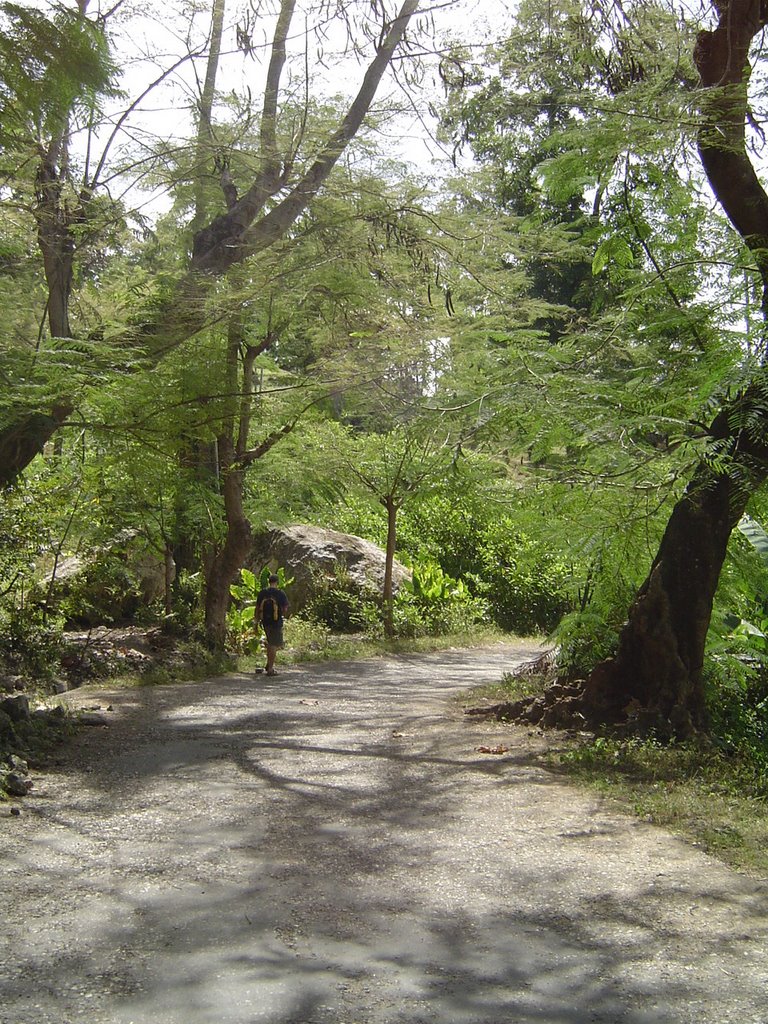
The beach at the bottom was a bit average, but had a quick swim anyway, watched by about 12 kids who lined themselves up, as if for a show. As we began the walk back up the huge, looming hill, a mikrolet (public bus) cunningly purred along beside us and offered us a ride to the top. We ceded and hopped in.
Had a beer in the late afternoon at the town’s biggest hotel – the Pausada, pink and outlandish. They had 3 monkeys in a small cage; one was held to the ground by a 40cm chain attached to a rock. Not sure what custom this is: local? Indonesian? Portuguese?
Friday, 9 June 2006
couple of PNG snapshots

The Rainforest Habitat (Unitech, Lae) is worth a visit if you ever head down that way. I’ve visited Lae before, but hadn’t been to this spot until I went on Monday. There are a lot of tree kangaroos (the largest collection of the species in the world; a lot are in medium-sized cages out the back), lots of eagles and birds in general (including cassowaries and birds of paradise). The best times to go are when it opens (10am) and just before closing (say 3ish; closes at 4); these are feeding times and everyone’s waking up and having a stretch (it gets very hot during the day and the best spot is somewhere dark and shady; not good for two-legged visitors who want to peer at wildlife).
There’s currently a volunteer down there (“Since his arrival three weeks ago a new computer was bought…”), a bloke from my home town’s zoo: Gert Skipper. (Or that’s the name he goes by. Sounds a bit like something you might make up if you were on the run, pretending to be a zoo keeper…Sorry Skipper. Just kidding.) It’s cheap – only 7kina – and there’s even a café in the first big aviary-enclosure you visit. Recommended.
**
We’re in our dry period in Goroka. Beautiful sunny days, cold nights. Bit dusty. And the ground is cracking.
**
It’s pay fortnight today in the Eastern Highlands Province (pay fortnight = government and main business payday). Goroka town was busy; people from surrounding villages and more remote areas had made the trip in to hit the shops. There were trucks in from Bena and Lufa and community schools, parked on the main street whilst everyone lucky enough to score a lift went and shopped. There were crowds around all of the supermarkets. People coming out were carrying bags bursting with rice, oil, tinned fish (mackerel or tuna), 2-minute noodles. Most of it will be eaten this weekend (probably with beer), before people go back to waiting for the next pay fortnight, returning to kaukau (sweet potato), a few greens (like pumpkin leaves, called pumpkin tips here), spring onions + rice or white bread rolls if you’re lucky (bread’s sweet here, with a lot of sugar).
The images of those bags of store goods are on my mind. In a few weeks they’ll be a fond memory: I’m moving out of GKA central, and heading down to some villages Kokoda way. Where there are no trade stores. Where there is no electricity. Where I’ll wash in a stream, or a waterfall. And where I’ll be collecting a few more stories for the memoirs.
Tuesday, 30 May 2006
more on timor
ABC Australia says: "A top-level crisis meeting between members of the East Timorese government is yet to reconvene. The meeting has so far failed to settle differences between President Xanana Gasmao and his prime minister, Mari Alkatiri. Our reporter in Dili, Peter Cave, says it is now apparent that the prime minister, who is widely blamed for the political and security crisis will survive, but that the president will emerge with control over national security and defence."
There was undisguised contempt and frustration with Alkatiri amongst the whiteskins when we were there - but apparently he had a lot of support amongst locals. Enough to maintain his position anyway. Yes there have been various triggers in the past couple of months, but one has to wonder about political intervention. How much of this has been allowed to escalate because of personal battles at the top? It's an age-old situation - the road to hell was paved with good intentions, remember - but it still depresses.
And so does the looting, destruction and burning of buildings. This will sound a little naive, but I was amazed at how actual amount of buildings that are ruined shells - all over the country. Alomst 40% of structures were burnt out holes, still empty 7 years later. These palpable scars covered the landscape. And more are being added?
Sori tru.
and in the meantime, keep reading dili-gence
There was undisguised contempt and frustration with Alkatiri amongst the whiteskins when we were there - but apparently he had a lot of support amongst locals. Enough to maintain his position anyway. Yes there have been various triggers in the past couple of months, but one has to wonder about political intervention. How much of this has been allowed to escalate because of personal battles at the top? It's an age-old situation - the road to hell was paved with good intentions, remember - but it still depresses.
And so does the looting, destruction and burning of buildings. This will sound a little naive, but I was amazed at how actual amount of buildings that are ruined shells - all over the country. Alomst 40% of structures were burnt out holes, still empty 7 years later. These palpable scars covered the landscape. And more are being added?
Sori tru.
and in the meantime, keep reading dili-gence
road trip, timor leste
One day in Timor, maybe a week and a half ago, we caught a bus out from Baucau. It was going east along the coast, then south down to the town of Los Palos; we wanted to stick to the coastal road so we got off at a village named Lautem. The plan was to catch a bus from Lautem to Com, a seaside village further east. We were unaware that there is very little traffic travelling this way. (If there had been a bus that day, it would have appeared very early in the morning; it was now around noon.) Seeing no bus, we decided to start the walk - 20kms to Com - and hopefully hitch a lift.
There was no traffic, no lift. We walked the 20kms.
On August 30 1999, the people of East Timor voted resoundingly for independence from Indonesian rule in a referendum. What followed was a nightmarish period of violence as the Indonesians withdrew; Indonesian army and police officers, and pro-Indonesian militia, killed hundreds; over half the population were displaced.
On September 25 1999, a militia team commander and several others drove from Com to Lautem. They said they were going to get rice from a warehouse near Lautem, but “[t]he most obvious indication that they were not in fact intending to get rice was that they drove right past the rice warehouse.” They were also armed with SKS automatic weapons (used by Indonesian security forces) and carrying machetes and knives.
About one kilometer past Lautem, the militiamen passed two young men pushing a cart. The militiamen chased the two men, hurling rocks and shooting at them. One of the men was wounded but managed to escape. The second was caught and tied to a tree near the side of the road.
The militiamen next set up a roadblock, placing large stones on the road. Some used a nearby hill as a lookout, and others took up positions in a ditch, aiming their weapons on the road. And then they waited.
“At about 2:30 p.m. the same day, a gray four-wheel drive vehicle came into sight from the direction of Lautem heading west toward Baucau. There were eight people in the vehicle, including two nuns, three Brothers/Priests, a journalist and two other lay persons.”
When the car stopped at the roadblock, three militiamen simply opened fire. The driver and some passengers were killed.
“As one of the surviving passengers tried to get out of the vehicle, a militiaman grabbed him and dragged him to the river where he was shot and killed. The same militiaman poured petrol over three other survivors and lit them on fire. One of the three ran from the car to the river”, but was shot and killed.
A nun got out of the car and, kneeling on the side of the road, began to pray. Someone slashed her with a machete. One of the nuns, Sister Erminia, got out of the vehicle and knelt down by the roadside to pray. As she prayed, a militiaman (Horacio) slashed her with a machete. Another militiamen shouted “Don’t kill a Sister!” but the commander roared: “Kill them all!”
Someone picked up the nun and threw her in the river, then shot her twice.
The militiamen pushed the car into the river. There was still one person alive in the car; he tried to get out, but was shot and killed.
The militiamen then remembered their earlier capture, one of the men pushing a cart who they had tied to a tree. One militiaman cut off his ear and hacked his neck with a sword, then pushed him into the river and shot him. “Finally [the commander] Joni Marques threw a grenade into the river, where the dead and wounded lay, to be sure that there would be no survivors.”
East Timor 1999 Crimes Against Humanity Geoffrey Robinson 2003
There was no traffic, no lift. We walked the 20kms.
On August 30 1999, the people of East Timor voted resoundingly for independence from Indonesian rule in a referendum. What followed was a nightmarish period of violence as the Indonesians withdrew; Indonesian army and police officers, and pro-Indonesian militia, killed hundreds; over half the population were displaced.
On September 25 1999, a militia team commander and several others drove from Com to Lautem. They said they were going to get rice from a warehouse near Lautem, but “[t]he most obvious indication that they were not in fact intending to get rice was that they drove right past the rice warehouse.” They were also armed with SKS automatic weapons (used by Indonesian security forces) and carrying machetes and knives.
About one kilometer past Lautem, the militiamen passed two young men pushing a cart. The militiamen chased the two men, hurling rocks and shooting at them. One of the men was wounded but managed to escape. The second was caught and tied to a tree near the side of the road.
The militiamen next set up a roadblock, placing large stones on the road. Some used a nearby hill as a lookout, and others took up positions in a ditch, aiming their weapons on the road. And then they waited.
“At about 2:30 p.m. the same day, a gray four-wheel drive vehicle came into sight from the direction of Lautem heading west toward Baucau. There were eight people in the vehicle, including two nuns, three Brothers/Priests, a journalist and two other lay persons.”
When the car stopped at the roadblock, three militiamen simply opened fire. The driver and some passengers were killed.
“As one of the surviving passengers tried to get out of the vehicle, a militiaman grabbed him and dragged him to the river where he was shot and killed. The same militiaman poured petrol over three other survivors and lit them on fire. One of the three ran from the car to the river”, but was shot and killed.
A nun got out of the car and, kneeling on the side of the road, began to pray. Someone slashed her with a machete. One of the nuns, Sister Erminia, got out of the vehicle and knelt down by the roadside to pray. As she prayed, a militiaman (Horacio) slashed her with a machete. Another militiamen shouted “Don’t kill a Sister!” but the commander roared: “Kill them all!”
Someone picked up the nun and threw her in the river, then shot her twice.
The militiamen pushed the car into the river. There was still one person alive in the car; he tried to get out, but was shot and killed.
The militiamen then remembered their earlier capture, one of the men pushing a cart who they had tied to a tree. One militiaman cut off his ear and hacked his neck with a sword, then pushed him into the river and shot him. “Finally [the commander] Joni Marques threw a grenade into the river, where the dead and wounded lay, to be sure that there would be no survivors.”
East Timor 1999 Crimes Against Humanity Geoffrey Robinson 2003
Monday, 29 May 2006
images from dili
 View of Dili airport from the plane.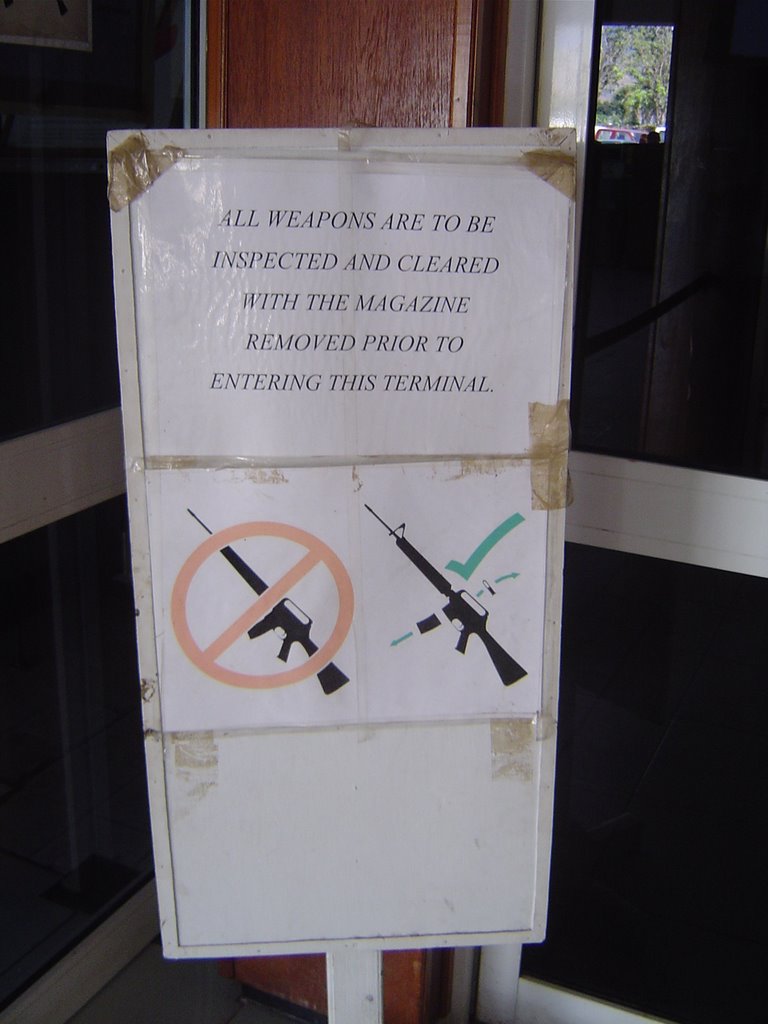
We saw the above sign at the airport, as we were leaving, and had a laugh about it. (And about the separate check-in desk reserved for UN personnel.) Less funny now.
"I can’t see things improving greatly for a number of days except if you are journalist. For them, this is what they get up in the morning for." We also enviously eyed some foreign correspondents, but as the above quote points out, there's ambivalence there too. Dili-gence writes some good tales about what has been happening, as it has been happening.
Still hard to reconcile good holiday memories with the terrible news of what has been going on in Dili. Had some excellent adventures, and have lots of stories, but still feeling a bit tired after a lot of travelling - and there's still a big pile of washing to do (how much I wish PNG had Bali's amazing cheap laundry services, where everything is scrubbed and comes back wrapped in plastic and only takes a few hours. Ah, travel can spoil you..) and work to get back into and oh some dirty harry movies to watch (yay! thanks n) and so stories will come later.
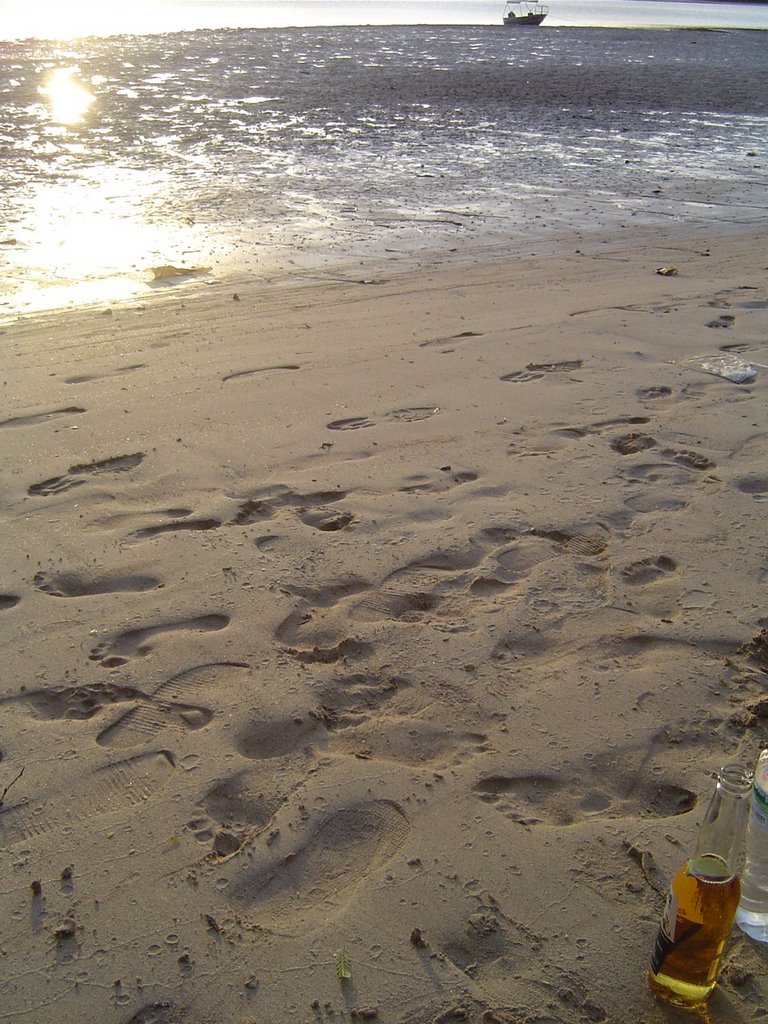 Dili beach, two weeks ago
Wednesday, 24 May 2006
so: bali
strange place - some great sections, but a lot of touristy places crammed full of shops shops shops. am amazed at how many shops they can squeeze into a block, and how many of these shops simply sell the same things. it all seems to revolve around shopping; if you don't buy into the capitalistic pastime there's almost nothing to do (and the beaches aren't all they're cracked up to be). but i'm just feeling a little jaded. flying in from a developing country into this makes you a bit cynical.
anyway, flying out tonight/tomorrow at 2.30am - onwards to jayapura - vanimo, png.
anyway, flying out tonight/tomorrow at 2.30am - onwards to jayapura - vanimo, png.
Sunday, 21 May 2006
dili update
dili = hot and quiet today. caught a bus back in to the capital from los palos; close to the city, passed a guy lying in the middle of the road, face-down; bus stopped, then roared on. Not sure what condition he was in. Up and over a ridge, a rock was thrown on to the bus roof; all the passengers looked scared and the bus driver put his foot to the floor. 5 mins later a branch was thrown on the bus. Everyone was silent now. When the trouble happened in Dili a few weeks ago, thousands (literally) of people fled Dili to their villages. Only now are they starting to come back (on our bus there was at least one full household + baggage moving back), but people are still very afraid. I'm not sure how real the risk is though; everything appears based on rumour. And other than that, we've had an excellent time - so much more safe and relaxed than PNG! Mixed feelings about returning to the secure-compound-restricted-life there - but hey that's still a week away. Tomorrow flying out to Denpasar
Saturday, 13 May 2006
air niugini? nogat
ok so last trip i did with air niugini, flight out was delayed 4 hours. flight back had two legs; both were cancelled and rescheduled and cancelled etc.
this time - flights ok. only - THEY LEFT MY LUGGAGE IN GOROKA
ps I love Cairns! Surprised, but true. Also - broadband 20mins AUS$1. Unbelievable.
this time - flights ok. only - THEY LEFT MY LUGGAGE IN GOROKA
ps I love Cairns! Surprised, but true. Also - broadband 20mins AUS$1. Unbelievable.
Wednesday, 10 May 2006
for both my sisters
 It is black and cold outside. My sister knocks at my door and we move together, starting up the road. Our house is positioned mid-way in a valley, half way up or down, at that mid point. Down is a dead end. To go anywhere, we have to hike up over a hill (the one to the front, the one to the side, or the one at the back).
 A big steep hill is right in front; here the run really starts. Down to our right – if you leap over a fence and roll downhill – is the freeway, also connecting to Melbourne. A few cars are moving along, their lights illuminating the way to Adelaide.
Somewhere around this time, I notice that the sky is changing. It’s gone from black, to black-blue. I hear some birds; I see the outlines of trees. Then it’s blue-black. Then that faint silvery blue that appears like a mist until suddenly it floods the sky, always happening so quickly.
We’re still running. Keeping up a steady rhythm fills up my mind; there’s no room for feeling amazed. But before this light comes, before the world sharpens back into the definitive real, there is a space that I remember now, about twelve years later. In that space the world is blue-black and I am jogging with my sister in a land of cut outs by jan pienkowski. I don’t need to look over to know that she’s there; things might be made of distinctions and sharp edges, but we’re not. It feels like we’re two arms of the same thing, running along a road through a forest, with the sky huge and beginning to swirl with colour, above us.
Monday, 8 May 2006
yes i did
On friday, to get a visa to visit a neighbouring country, I had to officially declare that I had been briefed by their embassy about "the recent security situation at the border" (um...no...) and that I am willing to "bear all the risk that might be occurred and will excemption the Embassy and the Republic ... from any object or subject of sue or law or policy".
And err they currently have my passport and I well kind of need it to leave the country on Friday and it's now getting a little close, particularly if we remember that this is PNG where anything can happen ... So did I sign away my rights? Yep.
And err they currently have my passport and I well kind of need it to leave the country on Friday and it's now getting a little close, particularly if we remember that this is PNG where anything can happen ... So did I sign away my rights? Yep.
Sunday, 7 May 2006
coffee ball, 2006
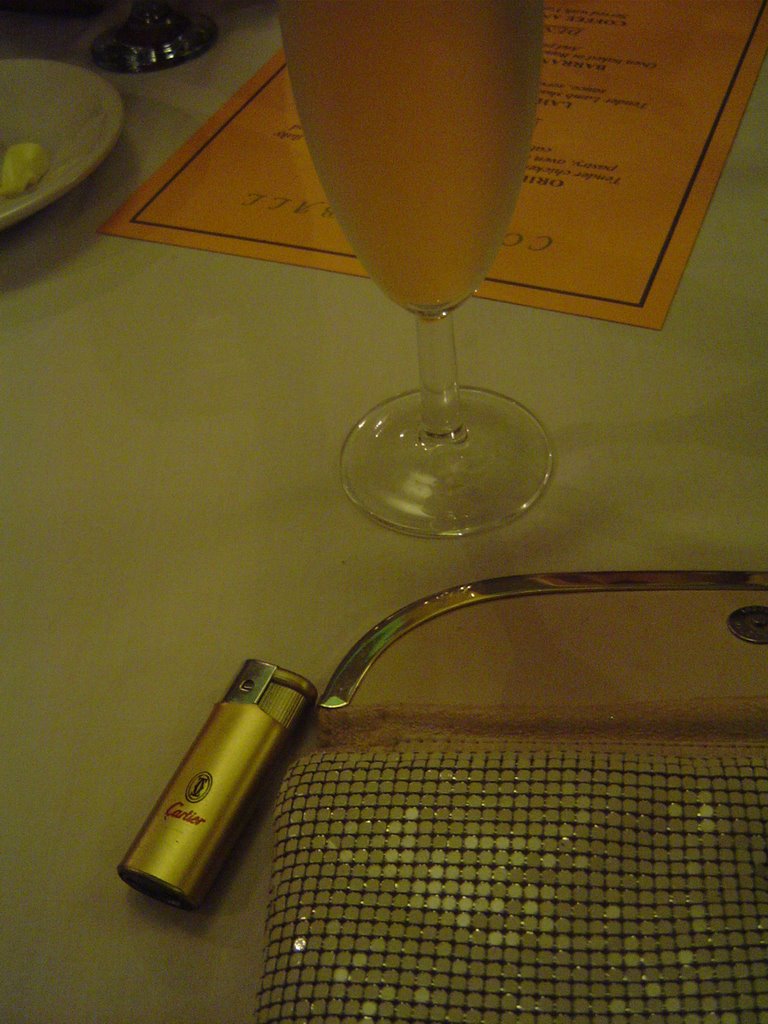 Last night was THE social event on PNG's annual social event calendar (on which there is...well nothing else up here in Goroka): the coffee ball. The theme was gold. There were predrinks at a friends place, and then a predrink in the downstairs bar, before heading upstairs to join a queue to get inside (so much like a school formal). There were little corsages for the ladies upon entry (nice touch) and gift bags (one per 16 person table) with perfume, gold cartier lighters (bottom of pic) and golden bows that were broaches. Unexceptional food came and went. There was terrible music, but a bit of dancing (one mate drunkenly danced with the governor of our province, something I will tease her about forever). There was the company of some excellent friends. It was probably the last coffee ball I will ever go to; feeling a bit tarnished today, but will be right by tomorrow. And now I'm just waiting to get my passport back from the Indonesian embassy - hopefully with a visa inside it - and will head off for some more adventures on Friday. 5 sleeps.
Saturday, 6 May 2006
another one from the festival
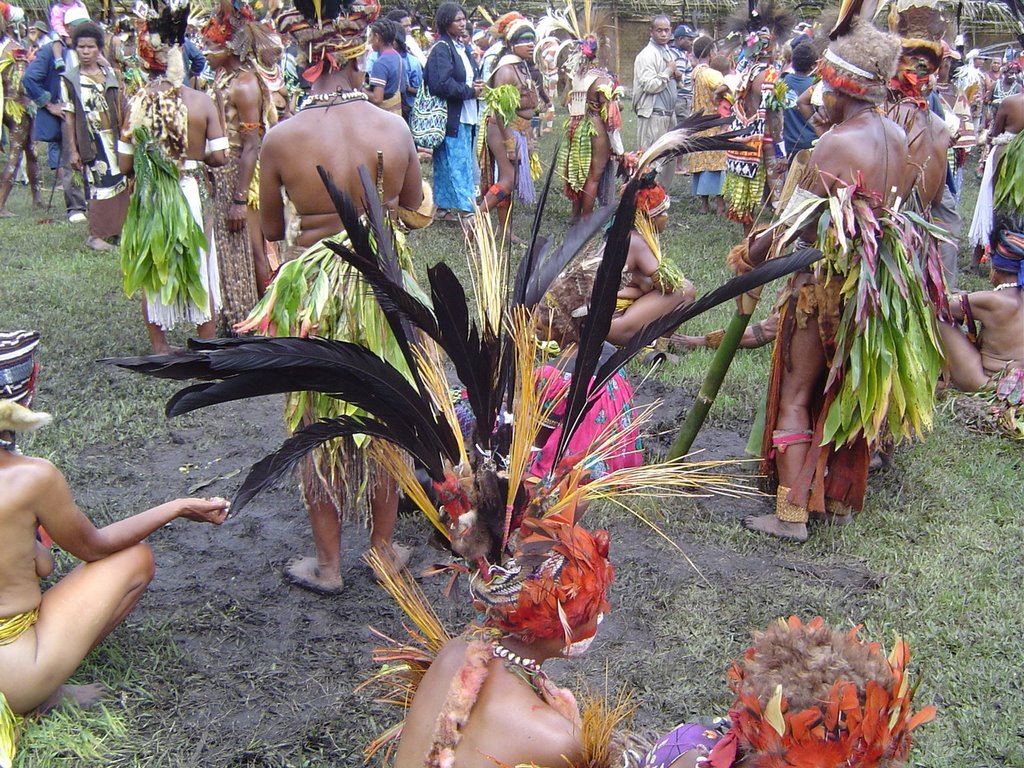 There's so much to look at that you often don't notice simple but stunning touches, like a headress. Until a tired performer sits down in front of you and there's a different view.
Thursday, 4 May 2006
looking damn fine
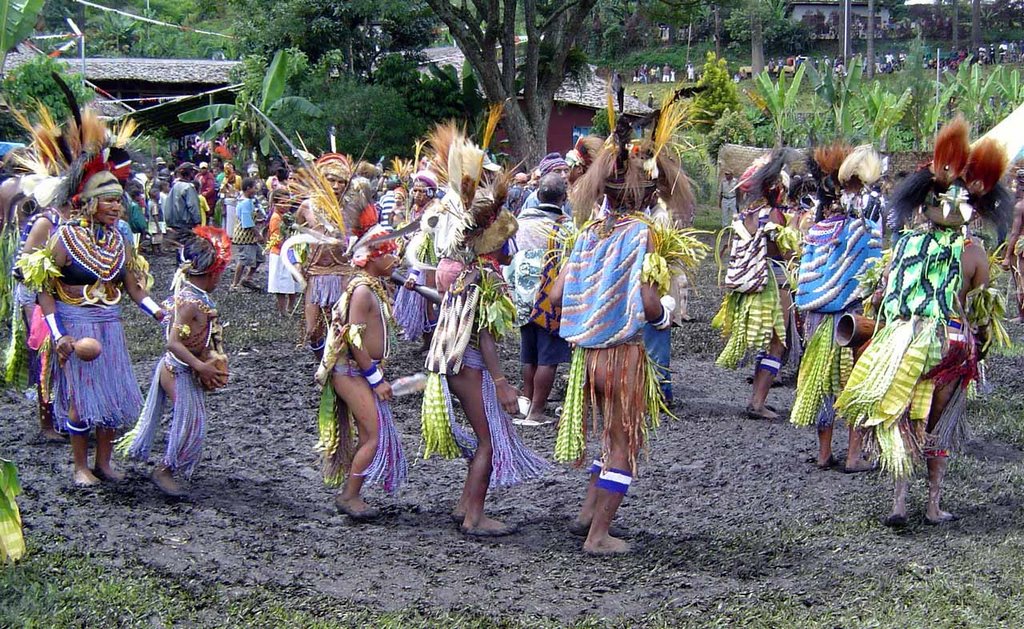 I went to the coffee festival today. I went last year as well; and overall last year was a bit better – it hadn’t been raining as much, so it wasn’t so muddy; there were a few less stalls but better organised (rather than this year: few more stalls, but no organisation at all, just, say, a sign). But also last year I knew less – so who had a stall and who didn’t was something I didn’t understand – and last year the stalls themselves were interesting, whereas this year I could just walk on by … (only I didn’t; I was sucked in by the prisoner rehab program and bought prisoners’ peanut butter, and even prisoners’ peanut biscuits – not just for me, but enough to give away. I always fall for the prisoners! At Christmas I remember buying really crappy bookmarks made by local prisoners. Why? Why? It’s partly a joke, but…not entirely. And what was that pencil portrait of Osama bin Laden, hanging proudly in the local grammar school’s exhibit? And this must be one of the last places American British Tobacco can sponsor events and have their logo proudly displayed everywhere.)
 And yet there’s something about the coffee festival that’s better than the bigger, more famous Goroka Show later in the year. It’s smaller, and fewer white tourists come. Somehow – despite its commercial underpinnings – there’s a good feel about it.
The singsings and bilas are fantastic. What is captivating are the elements of innovation each time people get dressed up and prepare their dances; it might be a new thing for them, or it could simply be something that I myself haven’t seen before. But it’s those details that keep me fascinated.  And it’s also simply a lot of fun, being around people – and knowing a few – who are dressing up in their cultural finery, and feeling proud and beautiful. They show it off and each region is competitive and they’re looking damn fine and … it’s a feeling, too. (Also you ARE in amongst it: you can move amongst the dancers, get any pics you want, people are happy to pose, or not; no one has to stand behind a rope, and there’s no antagonism; it’s pretty good.)
This year too I saw a Tolai whipping dance: a man would hold out his bare arm, or offer his back, and another would, simply, whip it. It sounds barbaric, but there was a fair amount of performance in the offering of body parts, and the emphasis was on the stamina. A friend whispered that they rubbed something on their bodies beforehand to limit the pain; I’m not sure if it was true or not, but I have to confess that I was captivated by the whole thing. And it certainly attracted one of the biggest crowds.
Tuesday, 2 May 2006
we need some heroes
Our optimism, at times euphoria, was, of course, not quite justified. We all underestimated the power of the multinationals and the corrupting effects of power.
(Ulli Beier, reflecting on “the scene” in Port Moresby just before Independence)
**
Number of doctors in PNG:
In 2000: 275
In 2003: 191
**
- Few weeks ago: finance portfolio stripped from well-performing MP and passed on to corrupt Minister rumoured to keep PM comfortably endowed with cash
- Today: finance portfolio through latter Minister set to give out 35.6 million kina to MPs in open cheques (approx $400,000 each); they don’t have to submit project proposal or expenditure summary. It’s interpreted as $$$ to spend on getting re-elected next year.
- Today: magistrates desperately need $65,000 kina to fund leadership tribunals (charges and investigations into alleged crimes committed by leaders ie politicians).
[Don’t like their chances]
**
“The old men want to eat rice and tinned fish before the die. That’s the only thing they think about.”
[Young person I spoke to today. Oil has been found in the village. The community elders want to sign the first contract that's been offered by an international company - the one who found the oil. There's no thought of what they're signing away, as well as what they're signing up for. They don't even want to get a second opinion, or future payment options: they want cash, and they want the cash now. The young in the village are fighting to be heard, worried about the realities of development, thinking about local precedents.]
Sunday, 30 April 2006
the tolais and the whiteskin meri
 Last week I went to a local school’s 50th anniversary. It was a big celebration: one of the original founders (an Australian nun, who was 82) had come over for a week of festivities, culminating in this one day. A girl from Rabaul that I know had been teaching a group of female students some Tolai dances. This girl asked me if I would be willing to present the school founder with a few gifts, as they performed the dances. That was fine with me. Next she told me that she would provide me with my outfit: a meri blaus and a lap lap. This was also good.
What she didn’t mention was the bilas (the decoration). So on the day I put on the laplap and the meri blaus and twirled around and felt quite happy – and then was told to sit down so that I could be properly dressed. 45 minutes later I had small skirts of leaves tied around my upper arms, around my hips, and several across my chest. I had a feather headband, plus something like an imitation egg + feather + ferns tied to the top of my head (because my hair is like “soft rope” as someone recognised, they just used strands of it to tie the headpiece on to my head; you can imagine how fun it was getting that one out…). There was also a lot of body paint: white and green powder smeared or striped over my arms and neck and face, and a special red on my cheeks (this red looked great on everyone else, but on the whiteskin it turned bright orange).
I wasn’t convinced that the overall effect was a winner. But people – especially women – were fascinated and even moved that I was willing to be dressed according to their way. Their response was touching, and made the occasion less artificial. Some told me that I was very beautiful and many people stroked my arm or shook my hand.
I was given a basket to wear (the strap around my forehead, the bag sitting on my back), and a basket and a staff to present as gifts. The basket and the top of the staff had bunches of particular plants (I didn’t know their significance); the staff also had lengths of shell money attached to it. Individual little shells had been threaded onto long lengths of cane, which then lined the staff. Shell money is still used more than cash in a lot of coastal villages, but on this occasion it had a more symbolic value.
As the dancing began and I went forward to present the gifts, an announcer told the crowds (a thousand or so people) that I had been adopted by the Tolai community and was representing them in handing over these items. A bit started – adopted? Since when? – I put on a sombre, responsible look and handed over the gifts quickly, before escaping to the sidelines to watch the dancing with everyone else (as much as I could, anyway; lots of the crowd wanted to shake hands with the Tolai whiteskin now).
Initially I felt uncomfortable about the politics: the whiteskin dressing up in another culture’s costume, not knowing the significance of what she had to wear, or even of being asked to wear it. But, again, the sincerity of people’s reactions made me put that aside; what was important was their interpretation, I was just lucky to be able to take part. Dressing up in bilas was not something I expected to do in PNG. And it was a bit of an honour. And – I admit – all politics aside: it was fun.
Subscribe to:
Posts (Atom)